
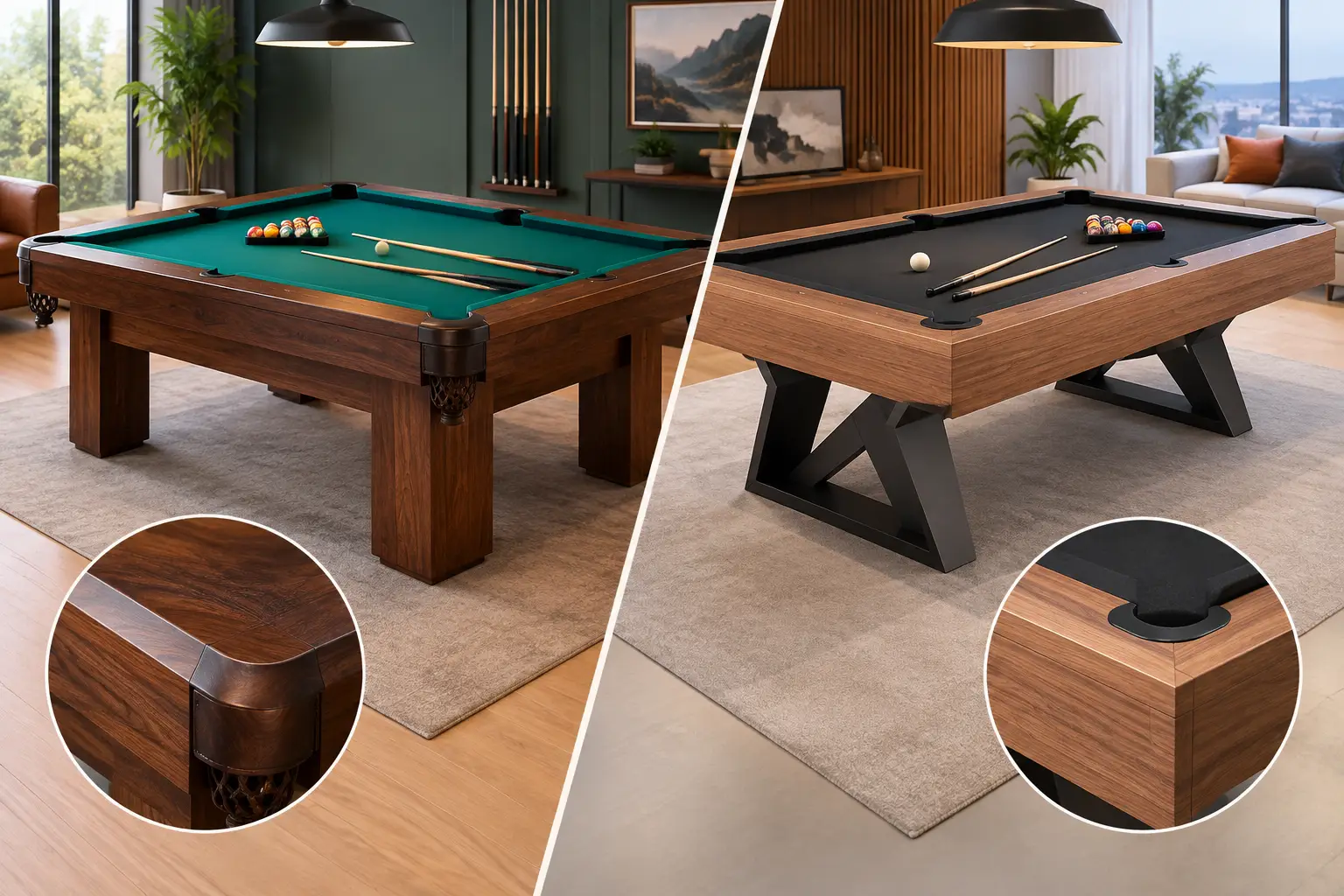
Solid wood versus veneer tables is not a cosmetic question when you are furnishing a game room. The cabinet is a major visual feature, but it also surrounds and supports a serious piece of equipment built to host family gatherings, weekend competition, and years of regular use. The right choice depends on how you want the table to look, what you expect from it over time, and whether the construction underneath matches the quality you are paying for.
For a long-term home pool table, solid hardwood construction is usually the stronger investment. That does not mean every veneered table is automatically a bad table. It does mean buyers should look beyond a beautiful finish and ask what is below the surface.
Solid Wood Versus Veneer Tables: The Real Difference
A solid wood table uses genuine lumber throughout the visible cabinet components, such as the legs, rails, aprons, and decorative trim. Premium pool tables are commonly built with hardwoods including oak, maple, walnut, or other furniture-grade species. The grain, weight, joinery, and finish all reflect real wood rather than a thin decorative layer applied over a manufactured core.
A veneer table has a thin sheet of real wood bonded to another material. That core may be plywood, MDF, particleboard, or another engineered panel. Veneer can look excellent, especially from across a room. In fact, a well-made veneer can create a consistent grain pattern that some homeowners prefer.
The concern is not the veneer itself. The concern is the material beneath it and the overall construction of the table. A hardwood veneer over quality furniture-grade plywood is very different from a printed wood-look surface over particleboard. Unfortunately, both may be described with broad terms like “wood finish” in a retail showroom.
When comparing pool tables, ask a direct question: Is this solid hardwood construction, hardwood veneer over plywood, or veneer over MDF or particleboard? A clear answer tells you far more than the color name on a finish sample.
Why Solid Hardwood Matters on a Pool Table
A pool table is not a dining table that sits quietly in a corner. It absorbs vibration, supports a heavy slate bed, and takes repeated contact from players leaning in for shots. A regulation-size table with 1-inch Brazilian slate is substantial equipment. Its cabinet, internal frame, and legs need to carry that weight without flexing, loosening, or becoming unstable over time.
Solid hardwood offers the density and fastening strength needed for durable joinery. Properly built hardwood components hold screws and bolts securely, which matters when a table is assembled, professionally leveled, moved, or serviced in the future. It also gives craftspeople more freedom to use substantial carved legs, detailed routing, traditional furniture profiles, and custom design elements.
For homeowners building a high-end entertainment space, that difference is easy to see. Solid wood has depth. The grain varies naturally, the finish gains character over time, and small wear marks can often be repaired rather than hidden.
That said, solid wood alone does not make a pool table tournament quality. A beautiful hardwood cabinet cannot compensate for thin slate, weak rails, poor cushion rubber, or a flimsy internal support structure. The best tables pair furniture-grade solid hardwood with 1-inch slate, strong cross beams, K66 gum rubber cushions, and professional installation.
When a Veneer Table Can Make Sense
There is a place for veneer in the market. A quality veneer table can be a reasonable option for a homeowner who wants a certain look at a lower price, plans to use the table lightly, or is furnishing a secondary room. Veneer may also provide a uniform appearance across wide panels where matching solid boards would be more difficult or expensive.
Engineered panel cores can be dimensionally stable in controlled indoor environments. That is one reason high-quality furniture manufacturers sometimes use veneer thoughtfully. The issue comes when veneer is used to make a lower-grade table look like a premium hardwood piece while the core lacks the strength needed for a heavy slate pool table.
A budget veneer table may be right for a short-term need. It is not usually the best fit for a homeowner who wants a made-to-order table to become a centerpiece of the home for decades.
Arizona buyers should also think about placement. A climate-controlled game room is ideal for any pool table. Rooms with extreme heat swings, direct sun, or poor humidity control can stress finishes and materials over time. Solid hardwood is repairable, but it still deserves a stable indoor environment. Veneer edges and lower-grade cores can be less forgiving if moisture, heat, or impact causes separation or swelling.
Durability, Repairs, and Moving Day
The difference between solid wood and veneer becomes more apparent after years of ownership. A solid hardwood rail or leg can often be refinished, touched up, repaired, or restored if it gets scratched during a move or marked by an enthusiastic game night. Natural wood gives you options.
With veneer, a surface scratch may be simple to disguise. But a deep gouge can cut through the thin wood layer, exposing the substrate underneath. Once veneer chips, bubbles, or lifts, the repair can be more involved and may never blend perfectly. If the underlying material swells from moisture, replacing a component may be the only practical fix.
This matters when a table eventually needs to move. Pool tables should be disassembled, transported, reassembled, and precision leveled by trained billiard professionals. The slate must be protected, the frame must remain square, and the rails must go back together correctly. A table with strong hardwood components and quality hardware is simply better prepared for that process than a low-cost cabinet made with lightweight composite materials.
Do Not Let the Finish Decide the Purchase
A dark espresso finish can make a veneer table look expensive. A lighter oak or weathered finish can make a solid hardwood table look casual. Neither appearance tells you enough about the construction.
Before choosing a finish, evaluate the table in this order: the slate and structural frame, the rail and cushion system, the cabinet materials, the quality of assembly, and then the style details that make it yours. That order protects your investment and still leaves plenty of room for design.
A well-built pool table can be customized to complement modern Scottsdale interiors, a rustic Prescott retreat, a traditional home in Peoria, or a polished Paradise Valley game room. Choose the wood species, stain, cloth color, pocket style, and leg design after you know the foundation is worthy of the finished look.
Questions Worth Asking Before You Buy
A reputable seller should be comfortable answering construction questions without vague language or sales pressure. Ask whether the visible wood is solid hardwood or veneer, what material is used for the internal cabinet and slate support beams, and whether the table uses one-inch slate.
You should also ask how the cushions are made, whether the table is professionally installed and leveled, what warranty applies, and who will handle future moves or repairs. These answers reveal whether you are buying a real long-term billiard table or a piece of occasional-use furniture dressed up as one.
At The Billiard Broker, a private showroom appointment gives Arizona homeowners time to compare wood species, finishes, cabinet styles, and performance components without the traditional retail markup or the pressure of a crowded sales floor. It is a practical way to see what solid hardwood construction feels like before committing to a table that will anchor your room.
The Better Value Is the Table You Keep
A veneer table may cost less at the beginning, particularly if it uses a composite core and entry-level components. But the lowest initial price is not always the lower cost of ownership. A table that cannot be refinished, moved confidently, repaired economically, or passed along to the next generation can become an expensive compromise.
For a primary game room, solid hardwood construction is typically the better choice when paired with professional-grade slate, cushions, and installation. It delivers the furniture quality homeowners want and the structural confidence serious play requires.
If you are comparing options, schedule an appointment before making a decision from a photo or a price tag. Run your hand across the finish, inspect the construction, ask what supports the slate, and choose the table that will still feel right after thousands of games have been played on it.