
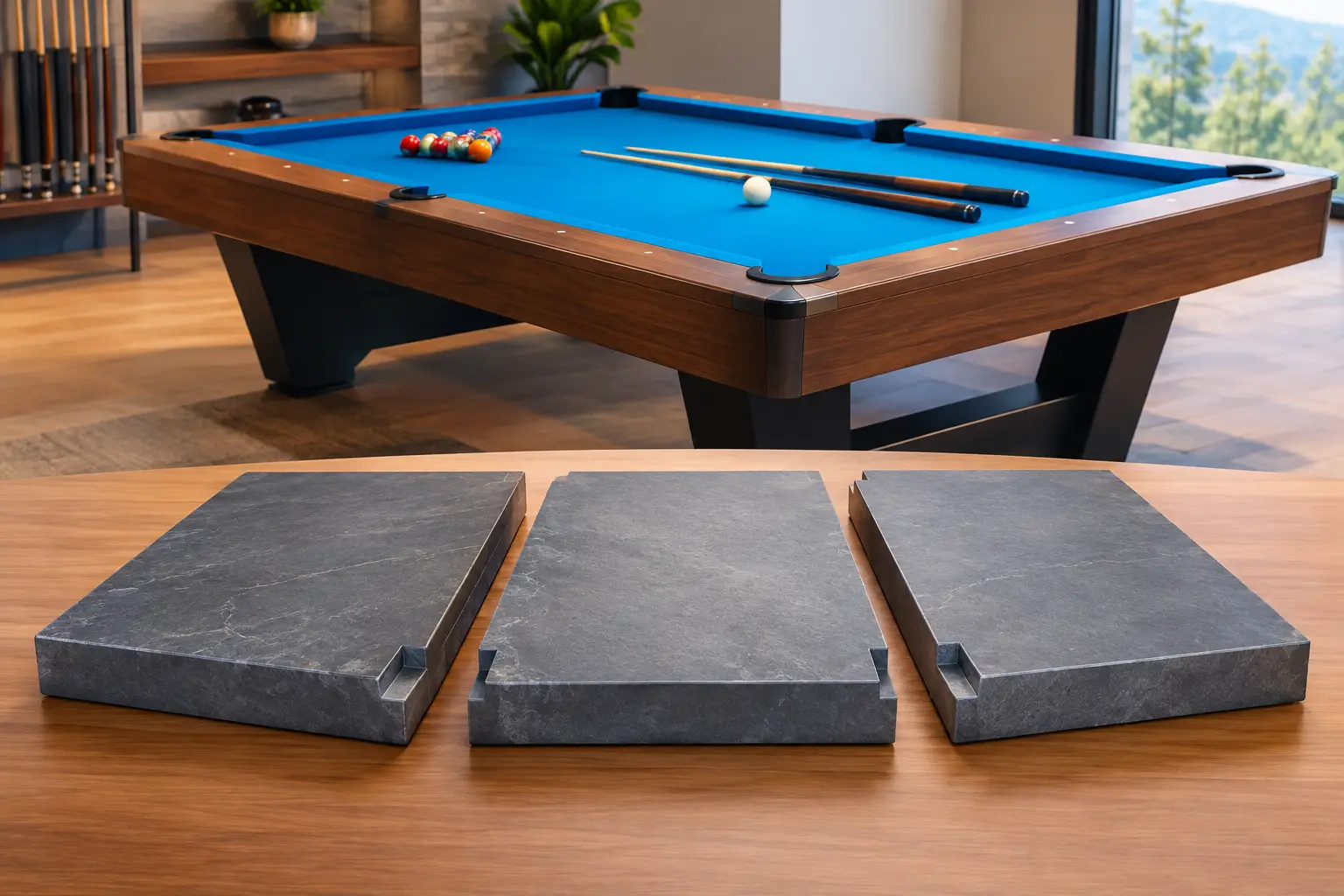
A pool table can look like a piece of furniture until the first serious game reveals what is underneath. In a proper three-piece slate comparison, the question is not whether seams exist. It is whether the slate, frame, cushions, and installation work together to create a level, consistent playing surface for decades.
For Arizona homeowners investing in a game room, bonus room, or entertainment space, three-piece slate is usually the smart standard. It makes delivery more manageable, supports precision leveling, and gives you a table that can be professionally moved and reinstalled when life changes. The key is buying a table with real structural quality behind the slate, then having it installed by people who understand billiards.
What Is a Three-Piece Slate Pool Table?
A three-piece slate table uses three individual sections of billiard slate, typically cut to fit across the width of the table. Once the table is assembled, a professional installer aligns the sections, levels each piece, fills the seams, and stretches the cloth over the entire bed. When the job is done correctly, you should not feel or see the seams during normal play.
Premium home tables commonly use three pieces of 1-inch slate. At The Billiard Broker, that means 1-inch Brazilian slate paired with solid hardwood construction, K66 gum rubber cushions, and tournament-grade wool felt. Those details matter because slate alone cannot compensate for a weak cabinet, poor rails, or an unstable foundation.
A three-piece slate design is not a budget shortcut. It is the construction method found on many high-quality residential and commercial tables because it solves real ownership issues: getting a heavy table into the home, achieving accurate leveling, and servicing the table later without compromising its value.
Three-Piece Slate Comparison: Seams vs. Performance
The most common concern buyers raise is simple: Will I feel the seams? On a properly installed table, no. The slate sections are carefully aligned, secured to the frame, leveled, and joined with a seam filler before the cloth goes on. A ball should roll smoothly across the entire bed, including where the slate sections meet.
What causes bad play is not the fact that a table has three slate pieces. Bad play comes from poor installation, a frame that twists under weight, slate that is too thin, loose rail bolts, worn cushions, or a table that has shifted over time. A low-priced table can have slate and still play poorly if the rest of its construction is not built to hold its setup.
That is why a true comparison should focus on the complete system. A 1-inch slate bed on a durable hardwood frame, installed and leveled professionally, is a far stronger long-term investment than a table sold with vague material claims and dropped off without precision setup.
Why installers prefer three pieces
Slate is extremely heavy. A 9-foot table with 1-inch slate can weigh well over 1,000 pounds once the cabinet, rails, and hardware are included. Moving one large slate slab through hallways, stairwells, tight entries, and upstairs rooms is often impractical or unnecessarily risky.
Three sections allow professional installers to bring the table in safely, assemble it in the room where it will live, and make fine leveling adjustments at the slate itself. This is especially valuable in Arizona homes with upstairs lofts, narrow interior turns, or remodeled spaces that were never designed around a one-piece table.
It also protects your options later. If you relocate within Phoenix, Scottsdale, Peoria, or elsewhere in the state, a three-piece slate table can be disassembled, transported, and reinstalled correctly. A quality table is meant to stay with the family, not become a moving-day problem.
Three-Piece Slate vs. One-Piece Slate
A one-piece slate bed has no slate seams, which sounds like an automatic advantage. In a controlled setting, it can be. One-piece slate is common in some commercial coin-operated tables, where the cabinet and slate are designed as a single unit and the table is delivered to a ground-floor location.
For most homeowners, however, the trade-off is access. A one-piece slate is harder to move, more difficult to get through a home, and far less practical to relocate. It may also limit the rooms where the table can be installed. If you have a wide, direct entry into a ground-level game room and never expect to move the table, it can be worth considering. That is a narrower use case than many buyers realize.
Three-piece slate offers nearly all the playability benefits homeowners want with substantially better installation flexibility. After professional assembly, the practical difference in everyday play is not the number of slate pieces. It is the quality of the build and the quality of the leveling work.
Do Not Confuse Slate With MDF or Slatron
When comparing prices, make sure the lower quote is actually for a slate table. Some entry-level tables use MDF, particleboard, or a synthetic playing-bed material sometimes marketed under names such as Slatron. These alternatives can be lighter and less expensive, but they do not offer the same permanence as genuine slate.
Moisture, heat, and time can affect composite beds. They may warp, sag, or lose their flatness, and they generally cannot be restored the way a slate table can be re-covered and releveled. In Arizona, indoor climate control helps, but a pool table is still a long-term furniture purchase. It should be built for more than a few years of casual use.
Slate holds its shape, supports accurate ball roll, and can be serviced repeatedly over its lifetime. That matters if your family plays every weekend, if you are stepping up from an entry-level table, or if you want a game room centerpiece that still performs after the kids grow up.
What to Look for Beyond the Slate
A good three-piece slate table earns its value through the components around the bed. Before comparing prices, ask exactly what is included in the construction and installation.
Look for these five points:
- 1-inch, precision-machined slate rather than a thinner playing surface.
- Solid hardwood construction or a cabinet engineered to support the weight of slate without flexing.
- K66 gum rubber cushions for reliable rebound and consistent banking.
- Quality wool or wool-blend billiard cloth that is properly stretched during installation.
- Professional delivery, assembly, and leveling rather than curbside drop-off.
The rails deserve special attention. Cushions affect every shot, and low-grade rubber can harden, dry out, or play inconsistently. A table can be beautifully finished yet frustrating to use if the rails do not respond predictably. Premium cushions and well-built rail assemblies are part of what separates a genuine playing table from decorative game-room furniture.
How Installation Protects Your Investment
Professional installation is where the three-piece design proves its value. The installer does more than put legs on a cabinet. They position and level the base, set each slate section, make precise adjustments, secure the slate, finish the seams, install the cloth, and rebuild the rails. The goal is a table that plays consistently from corner to corner.
A table should also be checked after it settles into its space. Flooring can vary, especially on tile, wood, concrete, or upper-level rooms. The right installer has the equipment and experience to make detailed adjustments rather than hoping a few leg levelers will solve the problem.
This is one area where a low initial price can become expensive. A poorly installed slate table may need to be disassembled and corrected later. Buying from a full-service billiards specialist gives you a clear path for delivery, future moves, felt replacement, cushion repair, and maintenance.
Value Is More Than the Sticker Price
Traditional retail pricing often hides major overhead in the showroom, staffing, and sales process. That does not necessarily mean the table itself is better. A comparable $5,000 retail table may be available around $2,495 through a dealer-direct model, depending on size, finish, cloth, pockets, and customization.
That savings should not require you to settle for a lower-grade bed or impersonal service. A private, appointment-only consultation gives you time to compare wood finishes, rail styles, felt colors, and table sizes without a high-pressure floor. It also lets you discuss the real details that determine whether a table fits your room and your family.
Before choosing, measure the room with cue clearance in mind, not just the footprint of the table. A 7-foot table can work beautifully in a tighter entertainment room, while an 8-foot or 9-foot table may better suit a dedicated game room and experienced players. The right size depends on the space, how you play, and whether design or tournament-style dimensions are your priority.
A three-piece slate table is a purchase you should feel good about every time you hear the break. Choose the construction that will last, insist on professional leveling, and buy from a team that will still answer the phone when it is time to move, recover, or service your table years from now.