
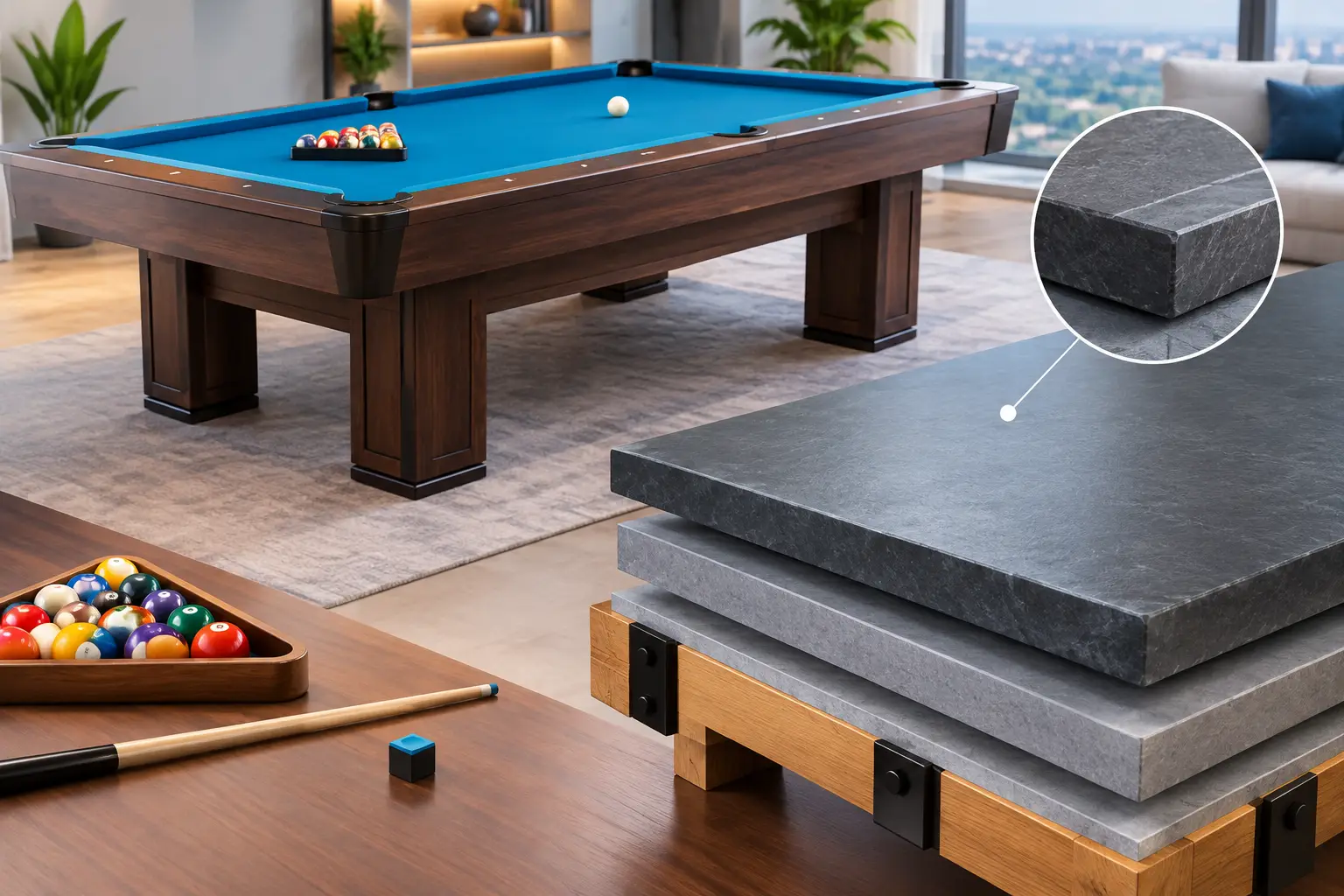
A pool table can look impressive under showroom lighting and still disappoint once the first serious game begins. In this slate thickness review, the real question is not simply whether a table has slate. It is whether the slate, cabinet, frame, cushions, and installation work together to give your family a level, accurate playing surface for years.
For Arizona homeowners furnishing a game room, bonus room, or upscale entertaining space, 1-inch slate is the standard worth understanding. It is not a decorative upgrade or a sales talking point. It is a major part of what separates a lasting home pool table from a piece of furniture that happens to have pockets.
Slate Thickness Review: 3/4-Inch vs. 1-Inch
Natural slate is prized because it can be machined to an exceptionally flat surface and remains stable over time. Unlike MDF, particleboard, or synthetic playing beds, it does not absorb humidity, swell, or lose its shape under normal use. But slate thickness still matters.
A 3/4-inch slate bed is commonly found on entry-level tables. It can provide acceptable casual play when paired with a decent cabinet and installed carefully. For a light-use table in a secondary room, it may be a reasonable way to reduce upfront cost. The trade-off is that thinner slate has less mass and less resistance to flexing, especially if the frame below it is underbuilt or the table is moved improperly.
A 1-inch, three-piece Brazilian slate bed is the benchmark for premium home tables and tournament-style play. Its added thickness and weight help support a flatter, more stable playing surface. The seams are professionally filled and the surface is precision leveled during installation, creating consistent roll from rail to rail.
That does not mean every player needs a commercial pool hall table. It does mean buyers who want a table to keep, rather than replace after a few years, should look beyond the price tag and ask what is beneath the felt.
Why an Inch of Slate Changes the Experience
The difference between 3/4-inch and 1-inch slate sounds small until you consider the full size of a pool table bed. On an 8-foot table, that added material is spread across a large surface carrying the force of play, the tension of the cloth, and the pressure of occasional leaning hands or accidental bumps.
A heavier slate bed is less likely to react to minor weaknesses in the cabinet or changes in floor support. It also gives a professional installer a better foundation for precision leveling. A ball rolling slowly down-table will reveal even slight imperfections. On quality 1-inch slate, properly installed, the ball should hold its line instead of drifting toward a low spot.
Slate thickness also affects the table’s overall feel. A solid table stays planted. The rails respond predictably, the playing surface feels substantial, and the table does not feel like a lightweight entertainment-room accessory. That matters when the table becomes the center of weekend games, holiday gatherings, and serious practice.
Still, slate alone does not guarantee quality. A 1-inch slate bed on a weak cabinet is not the same investment as 1-inch slate supported by solid hardwood construction and a substantial internal frame. Buyers should evaluate the complete system, not one specification in isolation.
The Construction Details That Support Good Slate
A quality slate bed needs a foundation that can carry its weight without sagging or shifting. This is where many lower-priced tables make compromises that are hard to see until after delivery.
Start with the cabinet and frame. Solid hardwood construction offers better long-term strength than particleboard-heavy furniture frames. Cross beams beneath the slate should provide real support across the table, not merely create the appearance of structure. The table’s legs also need to be properly joined and capable of supporting substantial weight on the specific floor where it will live.
Next, inspect the cushions. K66 gum rubber cushions are a preferred standard because they deliver a lively, consistent rebound. Cheap rubber can harden, lose shape, or produce dead rails, making even a perfectly level slate bed frustrating to play on. Good cushions, quality rail construction, and tournament-grade wool felt allow the slate to perform as intended.
Finally, ask how the table will be installed. A pool table is not level simply because the floor is level. Floors settle, tile has variations, and carpet compresses. Professional technicians level the slate itself, address the seams, stretch the cloth correctly, and test the table before they leave. That workmanship protects the investment more effectively than any quick delivery service ever could.
Three Pieces of Slate Are a Practical Advantage
Most premium 8-foot and 9-foot home tables use three pieces of slate rather than a single slab. Some buyers initially assume one solid piece must be better. In reality, three-piece slate is the practical choice for residential delivery, stair access, and precise on-site leveling.
Each section can be carried safely into the room, placed on the frame, aligned, and leveled as part of the completed playing surface. Once the seams are sealed and the cloth is installed, the table plays as one continuous bed. This approach is especially valuable in Arizona homes with upstairs game rooms, tight hallways, or rooms that are difficult to access from the garage.
The key is not avoiding seams. The key is having an experienced installer create seams that disappear beneath the cloth and remain stable through normal ownership.
When 3/4-Inch Slate May Make Sense
A fair slate thickness review should acknowledge that 3/4-inch slate is not automatically a bad choice. It can fit a buyer who wants a modestly priced table for infrequent casual play, has a limited budget, or is furnishing a short-term space. A well-built 3/4-inch slate table is still far better than a non-slate table for playability and serviceability.
The problem comes when a thin-slate table is marketed as equivalent to a premium table while hiding compromises in the frame, cushions, cloth, or installation. If the price looks unusually low, ask direct questions: Is the slate genuine? How thick is it? Is it one piece or three? What supports it? What type of rubber cushions are included? Who handles setup and future service?
Those answers reveal far more than a staged photo or a temporary sale sign.
Buying for Long-Term Value, Not Retail Markup
A premium 1-inch Brazilian slate table does not have to carry the inflated price of a traditional retail showroom. Dealer-direct buying and a private, appointment-only model can put the budget into the materials and craftsmanship that matter instead of expensive retail overhead.
That is the value proposition behind The Billiard Broker: made-to-order, American-made tables with 1-inch Brazilian slate, solid hardwood construction, K66 gum rubber cushions, and professional statewide delivery and installation. A typical $5,000 retail-style table can be available around $2,495 without asking a homeowner to settle for bargain-grade construction.
Customization also deserves attention. Your table should fit the room in more than just dimensions. Finish color, leg style, pocket choice, cloth color, and dining-top options can help it feel intentional alongside existing furniture and flooring. A well-selected table becomes a centerpiece for the home, not an oversized object competing with the room’s design.
Measure the Room Before You Choose the Table
Slate thickness is critical, but table size must work with the room. An 8-foot table is a popular choice for many homes because it delivers an authentic playing experience without requiring the footprint of a 9-foot tournament table. The right choice depends on both the table dimensions and the cueing clearance around every side.
As a practical rule, plan for the table plus roughly five feet of open space on each side for a standard 58-inch cue. Rooms with less clearance can still work with shorter cues in tight areas, but that should be a deliberate decision, not an unpleasant surprise after installation.
During a private showroom consultation, bring room measurements, ceiling-height details, photos, and finish samples if available. A guided conversation can prevent a costly sizing mistake and help narrow down the construction and design options that fit your home.
A pool table should feel solid on day one and play true after years of family use. Choose the slate thickness, construction, and installation team with that standard in mind, then schedule an appointment to see the difference in person.