
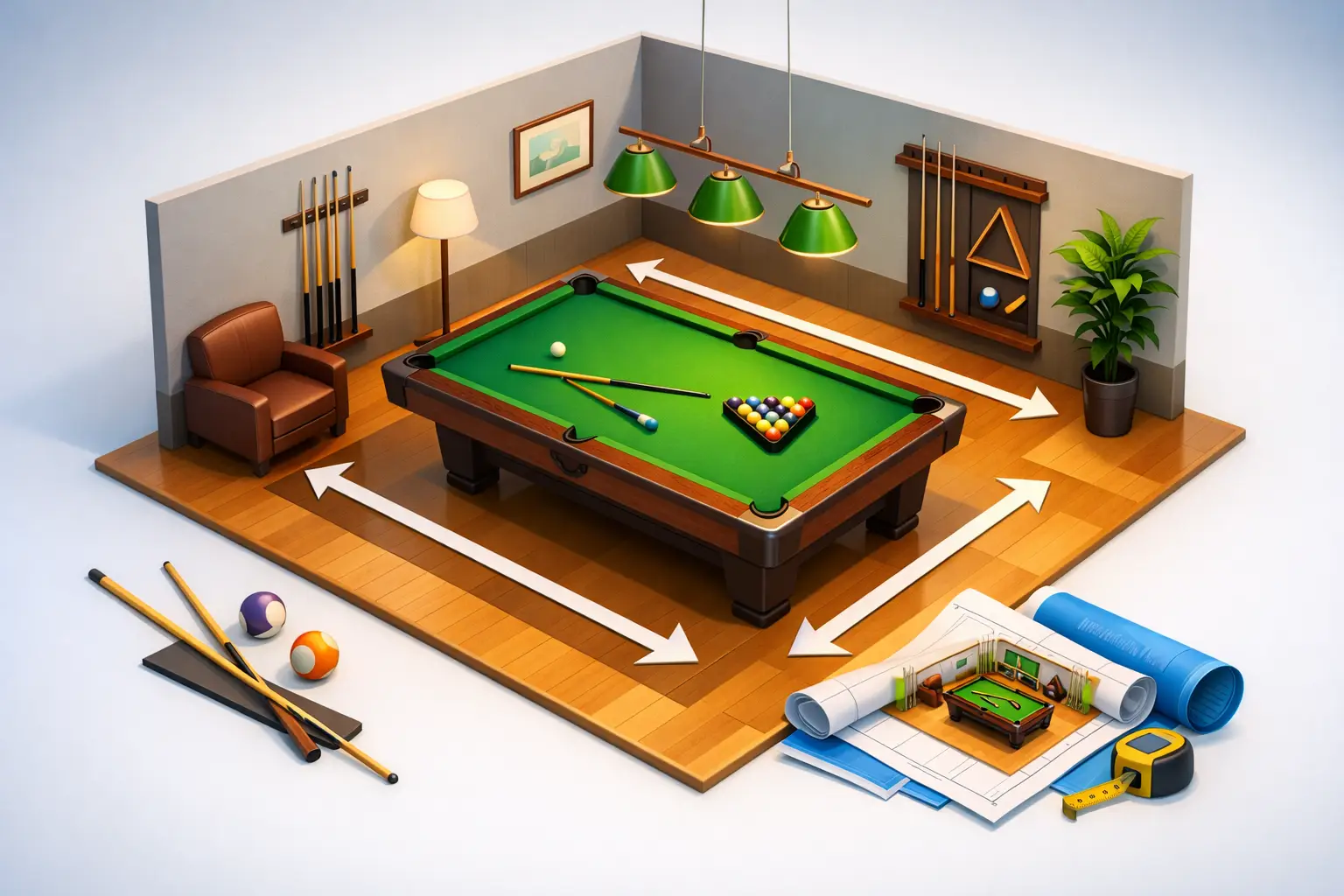
A pool table can look perfect on a floor plan and still feel frustrating the first time someone lines up a shot near the wall. The real answer to how much room for pool table use is not just the table’s outside dimensions. You need enough space to use a full-length cue comfortably from every side, plus room for people, furniture, and the way your family actually entertains.
For Arizona homeowners building a game room, converting a bonus room, or furnishing a dedicated entertainment space, getting this measurement right protects the investment. A quality pool table is built to stay in place for decades. It deserves a room that lets everyone enjoy it.
How Much Room for a Pool Table Do You Need?
Start with the playing surface, not the overall cabinet size. The basic formula is simple: add twice the length of your pool cue to both the length and width of the table’s playing area.
Most home players use a standard 58-inch cue. That means you need 58 inches of clear shooting space on every side of the table, or 116 inches total added to each playing-surface dimension.
Here are the minimum room sizes for the three most common home pool table sizes when using standard 58-inch cues:
- A 7-foot table needs about 12 feet 11 inches by 16 feet 2 inches.
- An 8-foot table needs about 13 feet 4 inches by 17 feet.
- A 9-foot table needs about 13 feet 10 inches by 18 feet.
Those are practical minimums for billiards play, not necessarily the dimensions of the room itself. If you want a sofa, bar seating, a shuffleboard table, arcade games, or a clear walkway around the action, give yourself additional space. A room that technically fits a table is different from a room that feels designed around one.
Why the Table’s Outside Size Is Not Enough
A common mistake is measuring the overall footprint of the pool table, then leaving a few feet around it. That approach makes the table fit physically, but it does not make it playable.
An 8-foot pool table, for example, has a playing area that measures 44 by 88 inches. Its cabinet, rails, and legs make the outside dimensions larger, often around 54 by 98 inches depending on the design. Yet a player needs room behind the cue to make a natural stroke. The clearance requirement is based on where the cue travels, which is why the playing surface is the right starting point for room planning.
This is especially noticeable on shots along the long rail. If a wall, sectional, fireplace surround, or bar is too close, players end up holding the cue upright, shortening the stroke, or reaching for a short cue on routine shots. That is not the experience you want from a premium home table.
The ideal room is larger than the minimum
Minimum dimensions are useful when you are deciding whether a room can work. Ideal dimensions create a better game room.
For an 8-foot table, a room around 14 by 18 feet usually provides a more relaxed setup. It gives players breathing room at the rails and allows for modest furnishings without turning every game into an obstacle course. If the room will host family gatherings, game nights, or watch parties, consider the traffic pattern as carefully as the cue clearance.
You should also account for doors that swing into the room, windows with deep sills, columns, built-in cabinetry, ceiling fans, and stair railings. Measurements taken wall to wall can be misleading when one side includes an architectural feature that interferes with a cue.
Choose the Right Table Size for Your Room
The right table is not automatically the largest one you can squeeze into the space. It is the table that delivers the best balance of playability, appearance, and how your household will use the room.
7-foot pool tables
A 7-foot table is a smart choice for compact game rooms, casitas, lofts, and multi-use spaces. It is also the familiar size found in many bars and casual leagues. With a room around 13 by 16 feet, it can provide enjoyable play without dominating the entire area.
The trade-off is that a 7-foot table has a shorter playing surface, which changes the pace and feel of the game. For a family-focused space or a room with limited square footage, that may be exactly the right decision. A well-proportioned 7-footer is far better than an 8-footer that leaves no room to shoot.
8-foot pool tables
For many homeowners, the 8-foot table is the sweet spot. It offers a substantial playing experience, looks at home in a dedicated game room, and remains more forgiving on room requirements than a 9-foot tournament table.
An 8-footer works particularly well in a 14-by-18-foot room or larger. It gives serious players enough table to enjoy, while still making sense for family play and entertaining. If you are furnishing a Scottsdale living space, a Peoria bonus room, or a larger Phoenix-area home, this is often the first size worth considering.
9-foot pool tables
A 9-foot table is the regulation tournament size and makes a strong statement in a dedicated billiards room. It is ideal for experienced players who want a more demanding game, practice regularly, or simply have the room to support it properly.
It also requires commitment. Plan on at least 14 by 18 feet for full-cue play, and more if the space will include seating or other recreation pieces. A 9-footer should feel intentional, not shoehorned into a room because it sounded like the most impressive option.
Can You Use a Pool Table in a Smaller Room?
Yes, but understand the compromise before you buy. Shorter cues can solve occasional tight shots near a wall. A 52-inch cue, 48-inch cue, or compact house cue can make a smaller room more usable. They are practical tools, especially in a room with one troublesome corner.
They are not a substitute for proper clearance on every side. If players need a short cue for half their shots, the room will feel restrictive and the game will suffer. Use short cues as a backup plan, not as the foundation of your layout.
A smaller room may be better served by a 7-foot table, a different furniture arrangement, or moving the table away from one feature that is taking up valuable cue space. Sometimes relocating a bar cart or choosing slimmer seating solves the problem. Other times, selecting the table size that fits correctly is the smarter long-term value.
Plan for More Than the Game
A great billiards room has a focal point, and the table is it. Still, the surrounding details determine whether the room feels polished or cramped.
Leave a natural entry path so guests are not walking through a player’s shot. Avoid placing bulky recliners directly behind a rail. If you want spectator seating, position it near the corners or along a wall with enough clearance to move it when needed. A wall-mounted cue rack and accessory storage can preserve floor space while keeping balls, brushes, and chalk within reach.
Lighting matters as well. A dedicated billiard light should illuminate the entire playing surface without creating glare or forcing players to look into exposed bulbs. Before selecting a fixture, confirm the ceiling height and the table’s final location. The center of the table should align with the light, not merely the center of the room.
For open-concept homes, define the game area with the table’s orientation, lighting, and a rug outside the playing zone if desired. Do not place a thick rug under the table unless it is designed for the purpose. A professional installer needs a stable, level foundation to properly assemble and level a slate table.
Measure Before You Shop
Use painter’s tape to mark the table footprint and the full cue-clearance area on the floor. Then walk through it. Stand where a player would stand. Open nearby doors. Pull out chairs. This simple exercise reveals problems that a sketch or online room planner can miss.
Take measurements at floor level, where the cue operates, rather than relying only on dimensions from a real estate listing. If you are unsure whether a room can accommodate a table, bring the measurements and a few photos to a private showroom consultation. An experienced billiards specialist can help you evaluate table size, layout, finish options, delivery access, and installation requirements before you commit.
The Billiard Broker helps Arizona homeowners make that decision with professional-grade, American-made tables and white-glove installation that includes precision leveling. One call can save you thousands compared with traditional retail pricing, but the bigger win is choosing a table that fits your home and your life from day one.
Before you fall in love with a style, measure the room honestly. The right pool table should invite people to play, stay, and come back for another game – not make them apologize to the wall before every shot.