
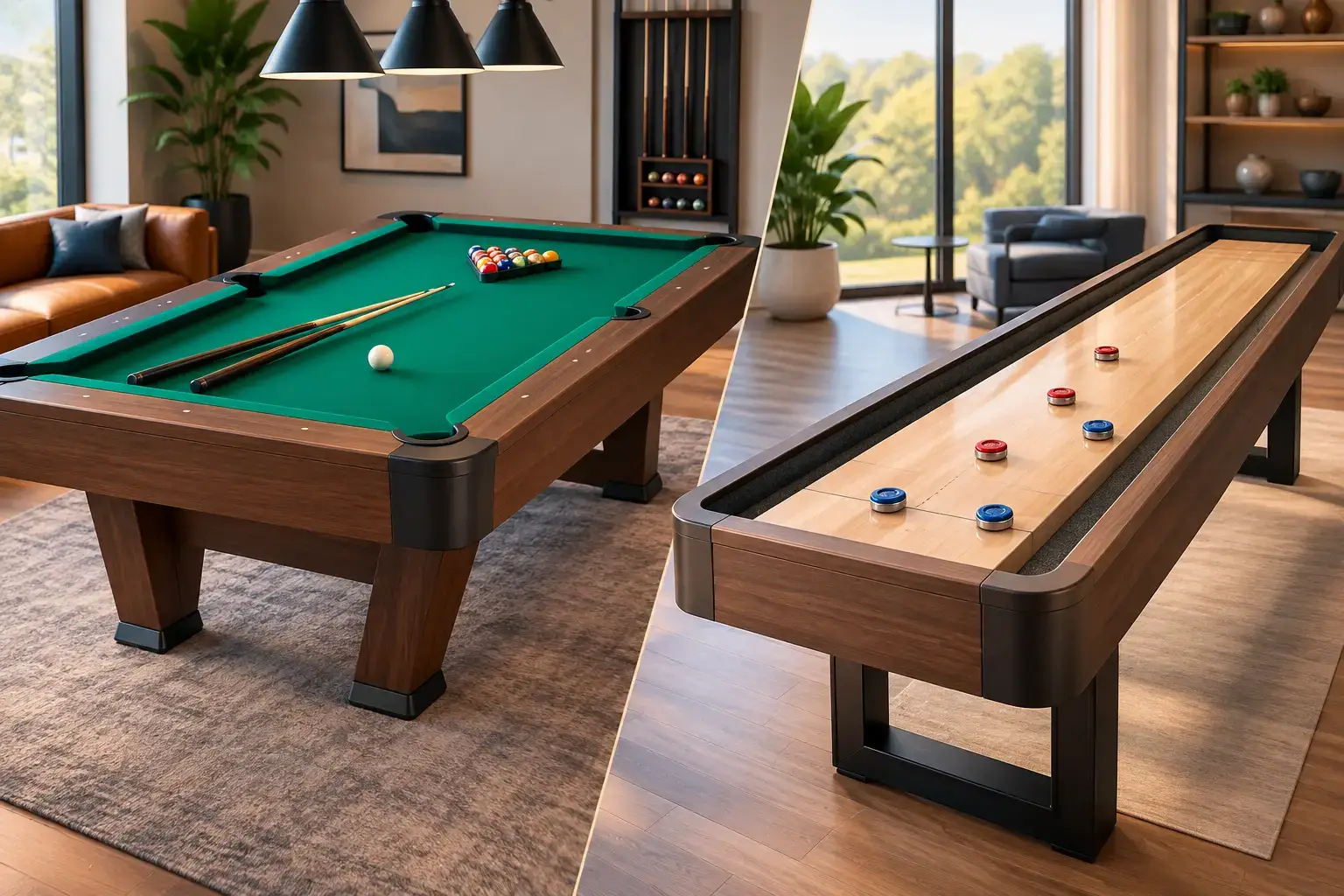
A game table should earn its footprint. It needs to fit the room, suit the people who will actually use it, and look right beside the finishes you invested in throughout your home. When homeowners compare billiards versus shuffleboard, the better choice is rarely about which game is more popular. It is about how you entertain, how much space you can truly dedicate, and whether you want a competitive centerpiece or an easygoing social table.
Both can become the table everyone gathers around. The difference is in the experience: billiards rewards shot-making, strategy, and repeat play, while shuffleboard invites quick games, conversation, and a relaxed pace. Here is how to make a confident decision before you buy.
Billiards Versus Shuffleboard: The Core Difference
A pool table creates a more complete game-room experience. There is a learning curve, but that is part of its value. Kids can learn the basics in an afternoon, while experienced players can spend years improving position play, bank shots, and cue-ball control. It works for casual family games, serious competition, and everything in between.
Shuffleboard is more immediately accessible. A guest who has never played can understand the objective after one frame: slide the puck close to the scoring end without sending it off the table. That simplicity makes it an excellent choice for parties, cocktail areas, and homes where the game is as much about visiting as it is about keeping score.
Neither table is automatically the “better” investment. A billiard table usually has broader appeal for households that want a true game room anchor. A shuffleboard table often shines in spaces designed for entertaining, especially when homeowners want a game that does not demand everyone’s full attention all evening.
Start With the Room, Not the Game
The most expensive mistake is falling in love with a table before confirming that the room can support it. A pool table needs clearance on every side for the cue. For a standard 8-foot table, a comfortable room size is generally about 14 by 18 feet when using standard 58-inch cues. A 9-foot table needs more room still.
You can use shorter cues in a tighter room, but that should be an occasional solution, not the plan for every shot. If a wall forces players to use a short cue constantly, the table will feel compromised no matter how beautiful it looks.
Shuffleboard is long and narrow, so its space requirements work differently. Common home shuffleboard sizes range from 9 to 16 feet, with 12- and 14-foot tables often fitting well in a bonus room, covered patio, or long wall in a great room. Players stand at one end rather than circling the entire table, which can make shuffleboard easier to place in a narrow layout.
Before deciding, measure more than the open floor. Account for door swings, bar stools, sofas, ceiling fans, columns, and the walking path people will use when the table is in play. A professional consultation can prevent an attractive table from becoming an obstacle.
When a Pool Table Makes Better Use of the Space
Choose billiards when you have a dedicated game room, a basement, a large bonus room, or an open entertaining area where the table can be the focal point. Pool tables hold visual weight in a good way. A solid hardwood cabinet, tailored finish, tournament-grade wool felt, and leather pocket options can complement anything from clean contemporary interiors to warm Southwestern design.
A well-built table is also more versatile than many buyers realize. It can be the place for family tournaments, a quiet solo practice session, or a late-night game with friends. If the room needs one major entertainment feature, billiards gives you more ways to use it.
When Shuffleboard Is the Smarter Fit
Choose shuffleboard when the room is long rather than wide, when you want a lower-pressure social game, or when your entertaining style revolves around a bar, kitchen, patio, or lounge area. Shuffleboard keeps players close together. That makes it especially good for couples, grandparents, and guests who may not want to handle a cue or learn billiards rules.
It can also be the right choice for a second game table. A billiard table in the game room and a shuffleboard table near the bar create two distinct ways to entertain without duplicating the same experience.
Consider How Your Family Will Actually Play
Billiards tends to win when a household has players who enjoy competition and improvement. The game changes as ability grows. A beginner can have fun sinking balls, while an experienced player can appreciate responsive K66 gum rubber cushions, accurate rails, and a table that stays level. Quality matters because inconsistent rolls and poor cushions make learning frustrating.
For homeowners buying a pool table as a long-term piece, construction should be non-negotiable. Look for a 1-inch Brazilian slate playing surface, solid hardwood construction, dependable cushions, and professional leveling during installation. These are not decorative upgrades. They protect playability and help the table remain a lasting part of the home instead of a short-lived purchase.
Shuffleboard often wins with mixed-age groups and frequent visitors. It is easier to play in short rounds, easy to pause for food or conversation, and forgiving for guests who only play once or twice a year. Its pace is less intense, but it can still become very competitive once players start protecting the scoring zone and knocking opponents’ pucks away.
Think honestly about your household. If your family already talks about pool nights, watches cue sports, or wants a game that will challenge teenagers and adults for years, buy the billiard table. If your goal is to make every gathering more interactive with almost no learning curve, shuffleboard may get more day-to-day use.
Design, Customization, and Long-Term Value
A quality pool table is furniture first and game equipment second. It occupies a central place in the room, so the finish, cloth color, leg style, pocket design, and overall profile need to work with the home. The strongest buying experience lets you select those details instead of settling for a one-size-fits-all retail floor model.
That customization is also where dealer-direct buying makes a meaningful difference. Traditional retail pricing can bury homeowners under showroom overhead and markup. The Billiard Broker offers made-to-order, American-made tables with premium components at pricing designed to avoid that conventional retail penalty. A table that might be priced around $5,000 through a typical retailer can be available around $2,495, depending on configuration.
Shuffleboard tables deserve the same design attention. Cabinet finish, cradle style, scoreboard details, and the look of the playing surface all affect whether the piece feels intentional in the room. Because shuffleboard tables are narrower, they can blend into a space more easily, but a well-made model still has presence.
Value should include ownership after delivery. A game table is heavy, specialized equipment. Professional delivery, assembly, precision leveling, future maintenance, and moving service matter, particularly for Arizona homeowners who may remodel, relocate, or convert a room over time. Saving money upfront means little if the table is poorly installed or unsupported later.
The Best Choice May Be Both, Just Not All at Once
For large homes with separate entertainment zones, billiards and shuffleboard complement each other exceptionally well. The pool table becomes the main event, while shuffleboard gives guests a fast, social alternative. But if you are selecting one table today, buy for the space and habits you have now, not for a future room that may never be built.
A private showroom appointment is the practical next step. Bring room dimensions, photos of your finishes, and a clear sense of who will play. You can compare cabinet styles, cloth colors, table sizes, and price points without a high-pressure retail environment. One informed decision can save you thousands and give your family a game table they will still be using years from now.
The right table is the one that makes people put down their phones, stay a little longer, and ask for one more game.