
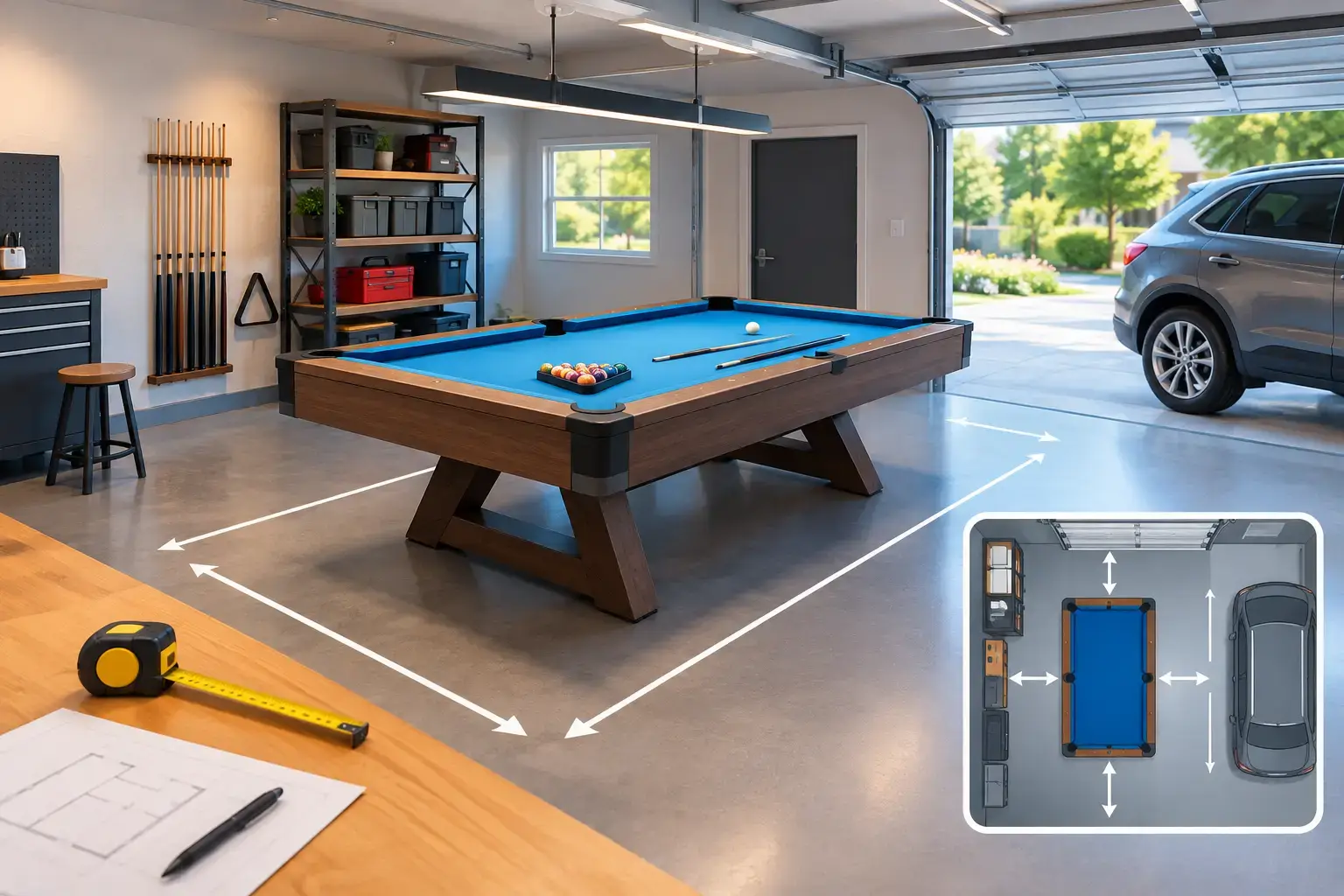
A garage can become the most-used room in the house once the cars, storage bins, and old equipment stop claiming every square foot. But can pool tables fit garages without turning every shot into a battle with a wall, workbench, or parked vehicle? Absolutely – provided you plan for the playing area, not just the table itself.
A quality pool table is a long-term piece of furniture with a precision playing surface. The right garage can make an excellent game room, especially for Arizona homeowners who want a dedicated place for family gatherings, game nights, and entertaining without giving up a formal living space. The key is choosing the correct table size, preparing the environment, and having it professionally installed and leveled.
Can Pool Tables Fit Garages? Start With Playing Clearance
The dimensions printed on a pool table describe the cabinet and playing surface. They do not include the space required to stand, bridge the cue, and make a full stroke. That clearance is what determines whether a garage is truly pool-table ready.
For most homes, plan around a standard 58-inch cue. A 7-foot table generally needs a room about 17 feet 3 inches by 13 feet 6 inches. An 8-foot table needs approximately 18 feet 4 inches by 14 feet 1 inch. A 9-foot tournament-size table calls for roughly 19 feet 4 inches by 14 feet 6 inches.
Those figures are practical minimums, not a promise that the room will feel spacious. Add a little more room if you want bar stools, spectator seating, a cue rack, or a sideboard for drinks. If you will use the garage for cars as well, measure with both vehicles parked inside and their doors open. A table that technically fits can still make everyday garage use frustrating.
Common garage layouts
A typical two-car garage is often around 20 by 20 feet or 20 by 22 feet. In many cases, that can accommodate an 8-foot pool table with workable clearance, particularly if the room is dedicated to recreation. A 7-foot table is often the smarter choice when storage, a refrigerator, gym equipment, or one vehicle must remain.
A three-car garage gives homeowners more flexibility. One bay can become a defined game-room zone while the remaining bays handle parking and storage. The distinction matters. A premium table deserves a planned setting, not a corner where it must compete with lawn tools and holiday decorations.
If your dimensions are close, shorter cues can help with occasional tight shots. They are useful solutions for one or two restricted areas, but they should not be used to justify placing a full-size table in a room that is fundamentally too small. Good play should feel natural from every side of the table.
Choose the Right Table Size for the Garage
A 7-foot table is not a compromise when it matches the space and the way your family plays. It is the familiar bar-table size, approachable for younger players, and an excellent option for a multi-purpose garage. An 8-foot table is the most popular residential choice because it offers a more traditional playing experience while fitting many dedicated two-car garages.
A 9-foot table is built for serious players and requires a larger, more intentional room. If the garage is oversized, climate-controlled, and dedicated to billiards, it can be an outstanding choice. Otherwise, an 8-foot table usually provides the better balance of playability, visual presence, and usable floor space.
Construction quality should remain a priority regardless of size. A table built with 1-inch Brazilian slate, solid hardwood, K66 gum rubber cushions, and tournament-grade wool felt will play consistently for years. Cheap tables can look appealing in a garage at first, but thin beds, weak frames, and synthetic materials often reveal their limits after temperature changes, moves, or heavy family use.
Garage Flooring and Leveling Matter More Than You Think
Concrete garage floors are durable, but they are rarely perfectly level. They may slope toward the garage door for drainage, and that is perfectly normal for a garage. It is not acceptable for a pool table.
Professional installers level the slate itself, not merely the cabinet. On a three-piece slate table, each section must be aligned, shimmed, secured, and sealed so the ball rolls true across every inch of the playing surface. This is detailed work. A table can appear level to the eye and still drift enough to disrupt a game.
Before installation, look at the floor condition. Cracks, uneven coatings, and major dips do not necessarily prevent a table from being installed, but they should be assessed in advance. Epoxy flooring can create a clean, upscale game-room look, while a large area rug beneath the table can soften the room and define the space. Just make sure the rug is flat, stable, and large enough that table legs remain fully supported.
Avoid moving a slate table across the floor after installation. A quality table can weigh 700 pounds or more, and dragging it can damage the floor, strain the frame, and throw off the leveling. Decide on the location before delivery, then let trained billiard technicians handle assembly.
Control Heat, Humidity, and Dust
Arizona garages present a different challenge than basements in colder climates: heat. An unconditioned garage can become extremely hot during summer afternoons. Slate is stable, but wood, cloth, rubber cushions, and leather pockets all benefit from a more controlled environment.
The goal is not to keep the garage at a perfect temperature every hour of the year. It is to avoid prolonged extremes and rapid swings. Insulating the garage door, sealing obvious gaps, adding a mini-split system, or extending home HVAC can make a major difference in both comfort and table longevity. Ceiling fans improve player comfort, although they should not blow strongly enough to disturb lightweight paper scorecards or create unnecessary dust movement.
Dust is another practical consideration. Garages naturally collect more airborne debris than interior rooms, particularly when doors open frequently. Use a fitted pool table cover whenever the table is not in use. Brush the felt properly, keep chalk away from the rails and floor, and avoid storing paint, chemicals, or dusty construction materials nearby.
Plan the Room Around How You Will Use It
The best garage game rooms feel deliberate. Consider sightlines from the door, overhead lighting, storage, and traffic flow before selecting a finish or table style. A traditional solid hardwood table can warm up an epoxy-floor garage, while a clean-lined contemporary design can complement a modern Scottsdale or Peoria home.
Lighting should be centered over the table and bright enough to see the entire surface without glare. The fixture should hang high enough to clear players but low enough to direct light onto the slate. Recessed lighting can supplement the room, but a dedicated billiard light creates the strongest playing environment.
You also need a path for delivery. Slate comes in heavy sections, and professional crews need a workable route through gates, doors, hallways, or garage access points. Measuring the room is only half the job. Measuring the route protects the table, the home, and the installation schedule.
Why Professional Delivery Is Worth It
A pool table is not assembled like a standard piece of furniture. Proper installation requires accurate slate leveling, cloth stretching, rail alignment, pocket fitting, and a final roll test. When the table is made to order, the finish, cloth color, pocket style, and design details should look intentional in the finished garage – not like an afterthought.
That is where a private consultation can save time and expensive mistakes. The Billiard Broker helps Arizona homeowners compare table sizes, confirm room requirements, customize a design, and arrange professional statewide delivery and installation. With dealer-direct pricing, buyers can put more of their budget toward real construction quality rather than traditional showroom markup.
A garage can be an excellent home for a pool table when the space is measured honestly, the climate is considered, and installation is handled correctly. Bring the room dimensions to your appointment, including door locations and permanent obstacles, and you can choose a table that plays as well as it looks for years to come.