
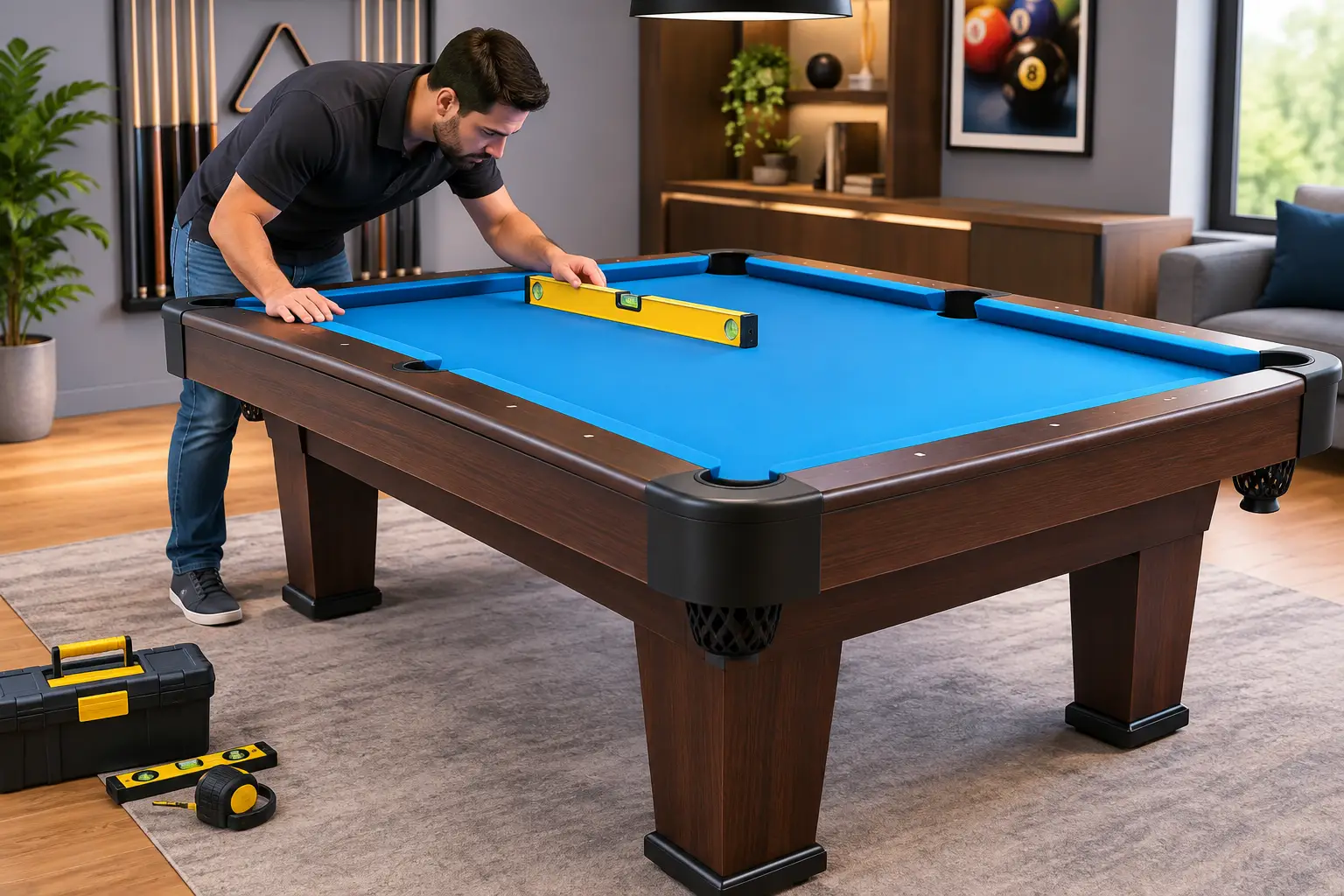
A pool table can look perfectly level and still play badly. A ball that slowly drifts toward one corner, a break that feels inconsistent, or a straight-in shot that misses with no clear reason often points to one issue: the table is not properly leveled. Knowing how to level a pool table helps you spot the problem, but leveling a quality slate table correctly requires more than turning a leg adjuster.
For Arizona homeowners, this matters from day one. A premium pool table is a substantial piece of furniture, a precision playing surface, and a long-term part of the home. It deserves an installation process that protects the slate, the frame, the flooring, and the quality of every game played on it.
Why a Pool Table Needs Precision Leveling
A pool table does not need to be level only at the rails or in the center. It needs to be level across the entire playing surface. On a properly installed table, a ball rolled gently in different directions should remain on its intended path rather than favoring one side, pocket, or corner.
Even a small error becomes obvious during play. Pool balls are designed to react to minute changes in the surface. A slight dip in the middle can pull slow shots off line. A raised slate seam can cause a ball to hop or wander. A table that is out of level from side to side may make one bank shot feel natural and the same shot from the opposite rail play completely differently.
The trade-off is simple: a basic furniture level may show that a table is close, but close is not good enough for a table built with tournament-grade components. Precision installation takes more time, yet it protects the investment and gives the table the honest, predictable roll buyers expect.
Before You Level a Pool Table, Check the Construction
The proper approach depends on what is under the felt. Most serious home tables use one-piece or three-piece slate. A three-piece slate table is common in premium residential and tournament-style designs because it can be transported into more spaces and leveled with exceptional accuracy. Each slate section must be aligned, supported, secured, and leveled as part of the whole surface.
This is not the same as leveling a lightweight MDF or particleboard game table. A 1-inch Brazilian slate bed is extremely heavy. Moving it incorrectly can crack slate, damage hardwood cabinetry, strain the frame, or create an expensive floor repair. If a table has been installed recently and only needs a minor adjustment, the process may be straightforward. If it has settled, been moved, or shows a visible seam issue, professional service is usually the smarter choice.
Also inspect the room before assuming the table is at fault. Many Arizona homes have tile, luxury vinyl, hardwood, or concrete floors that are not perfectly flat. A table can be carefully leveled on an uneven floor, but it must be supported correctly so the frame is not twisted to compensate for a major floor variation.
How to Level a Pool Table: Start With Accurate Testing
Remove balls, racks, accessories, and anything stored beneath the table. Clean the cloth lightly so dust or debris does not affect the test. Then use a quality machinist’s level or a highly accurate digital level. A short carpenter’s level can help identify a major issue, but it is not ideal for final billiard-table calibration.
Place the level in several locations: lengthwise near both long rails, crosswise near both end rails, and across the center. On a three-piece slate table, test directly around the seams as well. Record the readings instead of trusting one measurement. A table can appear level in the middle while being slightly low near a corner.
Next, perform a roll test. Place a clean cue ball on the cloth and roll it very slowly across several straight paths. Test from head to foot, side to side, and diagonally. Use a gentle roll, because a hard-struck ball can travel straight even when the surface is slightly off. If the ball consistently bends in the same direction, that confirms the issue.
Do not confuse cloth wear with a leveling problem. A worn, stretched, or improperly installed cloth can affect a very slow roll. So can a damaged ball. If the level readings are true but the cue ball still behaves oddly, inspect the cloth, seams, cushions, and balls before adjusting the table.
Make Small Adjustments at the Frame, Not the Slate
If your table has adjustable leg levelers and the issue is minor, adjust the levelers in very small increments. Raise or lower one point at a time, then retest. Large changes can shift the frame unevenly and create a new problem somewhere else.
Never place loose shims randomly under one leg without understanding how the table is supported. A temporary shim may correct a reading while leaving the frame under uneven stress. It can also compress, slide, or mark the floor over time. On a valuable hardwood table, the goal is stable support, not a quick fix that looks acceptable for a weekend.
For tables without leg levelers, installation technicians commonly use purpose-made shimming methods at the frame and carefully confirm the slate surface afterward. This is where experience matters. The frame must be square and supported before the slate is finalized. Trying to force a slate bed level over a twisted cabinet can create seams that eventually telegraph through the cloth.
If you adjust the legs, retest every location after each change. Leveling is not a one-reading job. A correction at one corner affects the measurements throughout the table.
Slate Seams Require Professional Attention
Three-piece slate tables are leveled section by section during installation. Technicians align the pieces, fill and smooth the seams, verify the surface with precision instruments, and then install the felt. If a table has a ridge, dip, cracked seam filler, or visible line beneath the cloth, simply adjusting a leg will not solve it.
This type of repair normally requires removing the rails and cloth, addressing the slate, and recovering the table. That sounds involved because it is. However, it is far less costly than allowing a small problem to become a cracked slate, torn cloth, or frustrating table that nobody enjoys using.
The same caution applies after a move. Pool tables should be disassembled, transported, reassembled, and leveled by billiard professionals. Dragging a fully assembled slate table across a room or attempting to move it to another home can damage the frame and knock the slate out of alignment, even if nothing looks broken at first glance.
When to Call a Professional Pool Table Installer
Homeowners can safely check level and make limited adjustments to a table designed for it. Call a professional when the table is new, has been moved, has three-piece slate, has no accessible leveling system, or shows symptoms beyond a simple low corner. You should also bring in help if the table rocks, the slate seams are noticeable, the cloth is wrinkled, or the floor has a pronounced slope.
Professional installation is especially valuable when you have invested in solid hardwood construction, 1-inch slate, K66 gum rubber cushions, and fine wool felt. Those components create a better playing experience, but only when the table is assembled as a precision system. Dealer-direct savings should never mean cutting corners on the final step that determines how the table actually plays.
At The Billiard Broker, professional statewide delivery and installation are designed to handle that final step correctly, from placement in the room through detailed leveling. For families furnishing a game room in Peoria, Scottsdale, or elsewhere in Arizona, that service protects both the table and the home around it.
Keep the Table Playing True Over Time
Once the table is level, avoid moving it unnecessarily. Keep indoor tables away from direct moisture and major temperature swings, and use a fitted cover when the table is not in use. Check the level again after a major flooring project, a relocation within the home, or a noticeable change in ball roll.
Normal household activity rarely throws a well-installed table dramatically out of level. Settling floors, a move, or an attempted DIY adjustment are more common causes. Catching a minor issue early gives you more options and helps preserve the cloth, slate, and cabinet finish.
A great pool table should reward a clean stroke, not make you second-guess the room. If a ball is telling you the surface is off, listen to it – then make the careful correction that lets your table play the way it was built to play.