
A pool table can either become the centerpiece of your game room or the one purchase you wish you had researched more carefully. A custom pool table gives Arizona homeowners control over the details that matter most: how the table fits the room, how it plays, how it coordinates with the home, and how well it holds up over decades of family use.
The goal is not to add options for the sake of options. It is to build a table that feels right in your home and performs like a real billiard table should. That means starting with the room, choosing construction that will stay true, and working with a dealer who can explain where your money is going without the inflated showroom markup.
Start With the Room, Not the Table Style
The first question is not, “What finish do I want?” It is, “What size table can my room handle?” A table may physically fit in a space while still leaving too little room for a comfortable shot. That is how a beautiful game room turns into a frustrating place to play.
A standard 7-foot table typically needs a room around 13 by 16 feet for full-length cues. An 8-foot table generally calls for about 13.5 by 17 feet, while a 9-foot table is best with roughly 14 by 18 feet. These are practical starting points, not hard rules. Shorter cues can help in a tight corner, but they are a compromise, not a substitute for proper clearance.
For most homes, an 8-foot table offers the sweet spot. It provides a more serious playing experience than a 7-footer while fitting comfortably into many bonus rooms, basements, and dedicated entertainment spaces. A 9-foot table makes sense when the room is truly built around billiards or when an experienced player wants tournament-style proportions at home.
Before ordering, measure every wall, doorway, stairway, and turn involved in delivery. Professional installers can disassemble and reassemble a slate table, but access still matters. A private showroom consultation should account for the entire path from the truck to the finished room.
What Makes a Custom Pool Table Worth Owning
Customization should never distract from construction. A table with a stylish finish but weak frame, thin slate, or low-grade cushions will not provide the consistent play buyers expect from a premium home table.
Look for a one-inch, three-piece Brazilian slate playing surface. Slate is the foundation of a level table, and one-inch slate provides the stability serious players want. Three-piece slate also allows professional installers to level each section precisely during setup. The difference becomes clear over time, especially in Arizona homes where temperature swings and settling can affect lesser equipment.
Solid hardwood construction is another detail worth protecting. Hardwood rails, legs, and cabinet components offer greater long-term strength than particleboard or thin veneers. A quality frame supports the slate correctly, resists movement, and gives the table the substantial feel that separates furniture-grade billiards from a department-store purchase.
Cushions deserve equal attention. K66 gum rubber cushions are a professional-grade standard for accurate rebound. Cheap rubber can harden, lose elasticity, or create dead spots that make shots unpredictable. Tournament-grade wool felt supports smoother ball roll and provides a durable playing surface for regular family use. Faster worsted cloth is also available for buyers who prefer a more competitive feel, though it can show wear differently and may not be the best fit for every household.
Make the Table Belong in Your Home
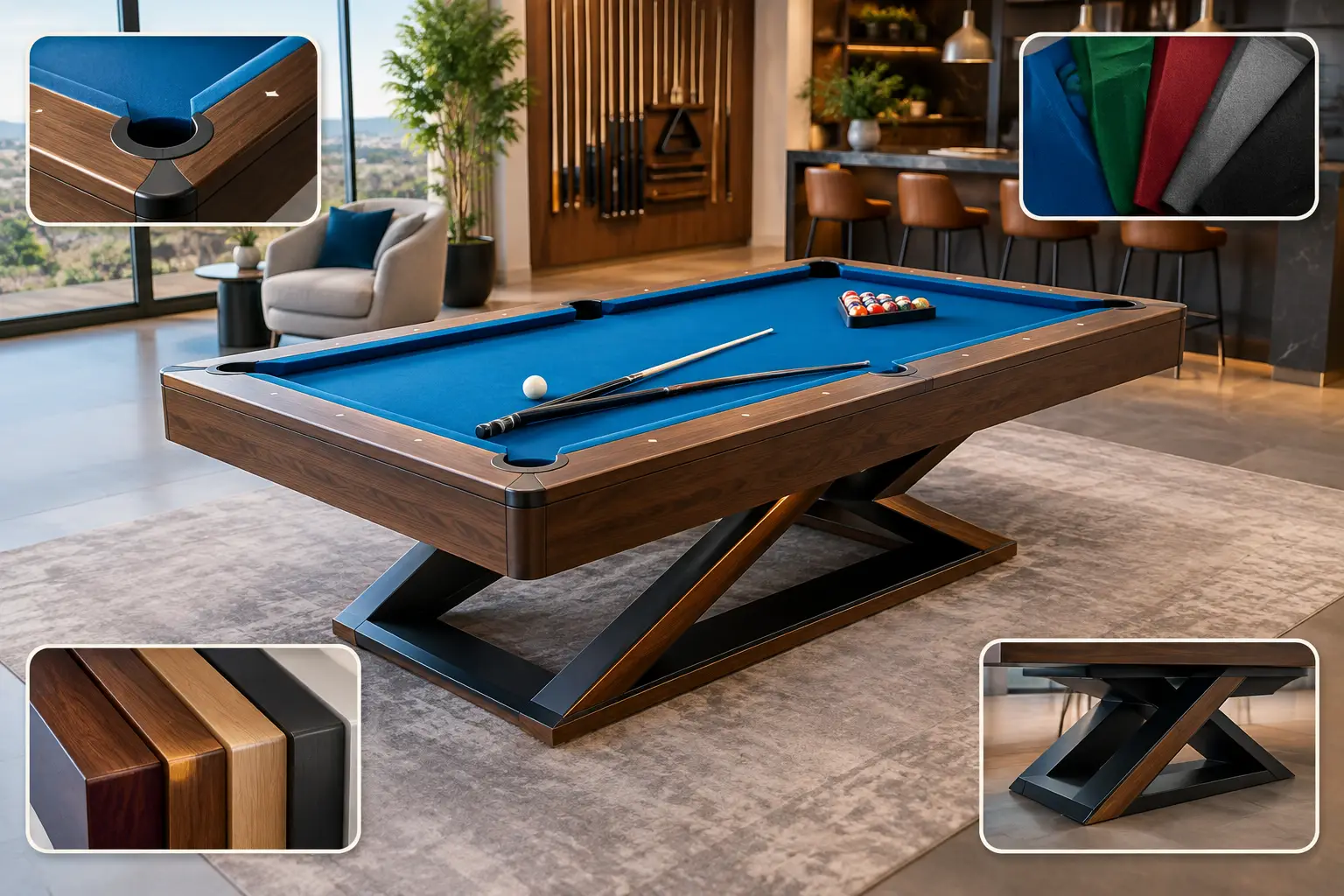
Once the performance foundation is right, the enjoyable part begins. A made-to-order table can be tailored to complement a contemporary Scottsdale great room, a rustic Prescott retreat, or a traditional Peoria game room without looking like an afterthought.
Finish selection has the greatest visual impact. Warm walnut, weathered gray, espresso, natural oak, black, and custom stains can all change the character of the same table design. Bring photos, flooring samples, cabinet finishes, or fabric swatches to the consultation. A finish that looks perfect under showroom lighting may read very differently beside your existing furniture.
Pocket style also changes the final look. Leather drop pockets bring classic character and work especially well on traditional and transitional tables. Shield pockets, fringe details, decorative sights, and rail inlays can add personality without making the design feel overdone. For a cleaner contemporary room, many homeowners prefer streamlined pockets and simple rail details.
Then there is the cloth color. Traditional green remains a smart choice because it hides everyday wear well and never goes out of style. Charcoal, navy, burgundy, camel, and tournament blue can make a stronger design statement. The best choice depends on how the room is used. A lighter cloth may brighten a dark room, while a deep neutral can help a table blend into a more refined entertainment space.
A Four-Step Way to Customize Without Guesswork
A major purchase should feel organized, not overwhelming. The right process keeps the decisions in the right order.
- Confirm the room and table size. Measure play clearance, delivery access, ceiling height for lighting, and the location of doors, windows, and furniture.
- Choose the table design and construction. Select a style that fits the home, then verify that it includes solid hardwood, one-inch slate, quality cushions, and dependable cloth.
- Coordinate the details. Pick the finish, cloth color, pocket treatment, sights, and any matching accessories such as a wall rack, cue stand, spectator chairs, or dining conversion top.
- Schedule professional delivery and setup. The table should be installed, leveled, assembled, and tested by trained billiard technicians, not treated like a boxed furniture delivery.
This sequence prevents a common mistake: falling in love with a finish before confirming whether the table size and construction are right for the room.
Premium Does Not Have to Mean Retail Markup
Many homeowners assume a well-built, American-made table must carry a conventional showroom price. Often, that price includes a large retail overhead before the table ever reaches the customer. Buying dealer-direct through a low-overhead, appointment-only model can change the equation.
A comparable $5,000 retail pool table can often be available closer to $2,495 when the focus is on direct manufacturer access rather than a high-rent retail floor. The exact price depends on size, wood species, finish, cloth, pockets, and accessory selections, so every build should be priced clearly before you commit.
The lowest advertised price is not always the best value. Be cautious when a quote does not specify slate thickness, frame material, rubber quality, delivery, assembly, leveling, or warranty coverage. A low initial number can rise quickly when essential services are added later. A transparent quote should tell you what is included and what is optional.
Made-to-order also requires patience. Custom finishes and specialty details take longer than buying whatever happens to be sitting in a warehouse. For most homeowners, that trade-off is worth it. You are purchasing a permanent piece of furniture and a real playing surface, not simply filling an empty corner before the next weekend gathering.
Installation Protects the Investment
Even the best table will not play properly if it is installed poorly. Slate must be positioned, joined, leveled, sealed, and covered with care. Rails need to be aligned correctly. The finished table should be checked before the installers leave.
Professional white-glove delivery is especially valuable for heavy slate tables. It protects your flooring, walls, stairways, and the table itself while removing the burden of trying to coordinate a complicated move with general movers. It also gives you one accountable partner if the table ever needs refelting, repair, maintenance, or relocation.
The Billiard Broker provides statewide Arizona delivery, precision installation, table moving, and ongoing service, so buyers are not left searching for help after the sale. That matters when your table is expected to stay in the family for years, or when a future remodel calls for moving it to another room.
For outdoor living areas, be realistic about exposure. A covered patio may be suitable for an outdoor-rated table, but an indoor hardwood table should not be placed where it faces direct sun, moisture, dust, or large temperature changes. The right product depends on the environment, not just the available space.
A well-chosen table creates more than a place to play. It gives family and friends a reason to put their phones down, stay a little longer, and enjoy the room you invested in. Schedule a private showroom appointment, bring your measurements and design ideas, and build the table around the way your home is actually lived in.